
How digitalisation is changing daily coordination on construction sites
07/09/2026
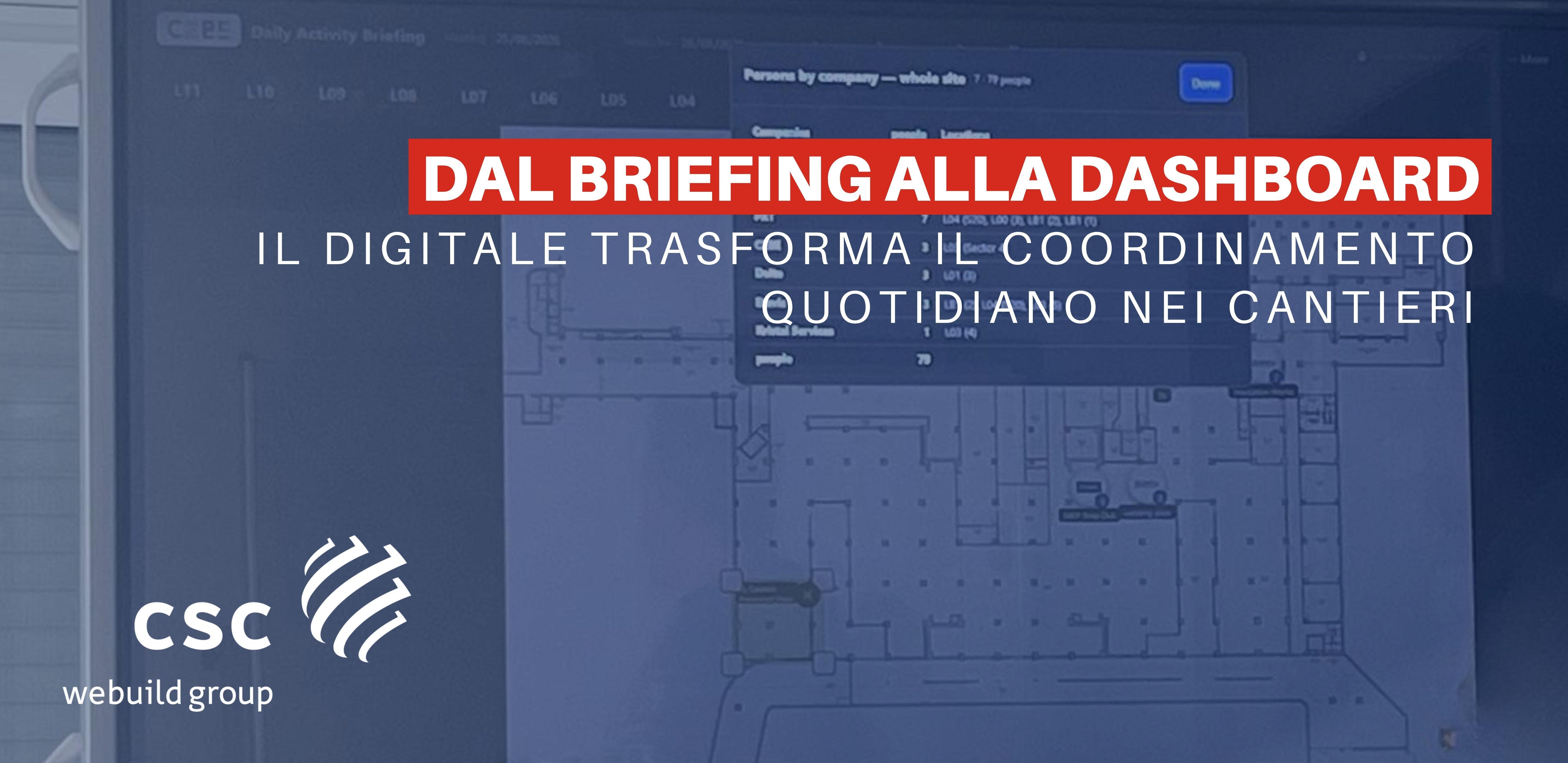
From whiteboard to touchscreen: how digitalisation is changing daily coordination on construction sites
At CSC Costruzioni, a digital tool developed in-house is turning the daily site briefing into a more structured, visual and traceable process
Every afternoon, on construction sites, contractors meet to coordinate the work planned for the following day: who will be on site, where each company will operate, how many people will be involved and which activities may present particular risks.
For years, this meeting was largely based on a whiteboard. One contractor after another would describe the planned activities while someone at the front of the room recorded them. Potential clashes were identified through discussion, the final board was photographed and the meeting was over.
The approach was familiar, but it had its limitations. Coordination was sequential, information was often transcribed by someone other than the people carrying out the work, and the final photograph provided only a snapshot of the discussion.
At CSC Costruzioni, part of the Webuild Group, the process has been redesigned through DABS – Daily Activity Briefing Board, a digital tool developed by the company to make daily coordination more visual, collaborative and traceable.
From discussion to a shared plan
DABS replaces the traditional whiteboard with an interactive touchscreen displaying the floor plan of the area under discussion.
The difference lies not only in the technology, but in how the meeting is conducted. Each contractor enters its own activities directly onto the plan, indicating the work to be carried out, the number of people involved and whether the activity is considered high risk.
All participants see the same information in real time.
This makes potential interference immediately visible. If two contractors plan to work in the same area or use the same access route, the overlap appears directly on the plan. The issue can therefore be discussed and resolved during the meeting, before it becomes an operational problem on site.
The system also identifies restricted areas. These are marked directly on the digital plan and trigger a warning if an activity is placed within them. Other areas requiring particular attention can be highlighted without preventing the activity from being entered.
The objective is simple: move coordination from verbal descriptions to a common visual reference.
A meeting with a defined sequence
The digitalisation of the process also introduces greater consistency into the meeting itself.
DABS can begin by importing the previous day's plan, allowing the team to work from an existing situation rather than starting from scratch. Attendance is then recorded company by company, followed by a review of activities classified as high risk.
Only once these elements have been reviewed does the system open the plan for editing.
At the end of the meeting, the entire plan can be exported in A3 format and distributed by email to the contractors involved. The same document therefore becomes the reference for the following working day, including for those who were not present at the briefing.
The result is not only a faster meeting, but also a documented record of the decisions taken.
Digital, but deliberately simple
Behind DABS is a deliberately lightweight architecture.
The tool runs directly from a browser and uses an existing SharePoint folder to store the daily records. There is no dedicated server, licence or software installation. A single file is generated for each meeting, creating a chronological record within the project's existing documentation structure.
The interface is available in English and French and can be operated directly from the touchscreen. Other computers can access the same board in read-only mode, allowing teams in the site office to follow the meeting in real time.
This simplicity is part of the concept: rather than introducing another complex platform into an already crowded digital environment, DABS focuses on one specific process and integrates it into the tools already used on the project.
Safety and traceability
The value of the system goes beyond saving time.
Daily coordination is also a safety process. Knowing which contractors are working in which areas, identifying high-risk activities and managing potential conflicts are essential elements of site management.
With a traditional whiteboard, much of this information disappeared once the board was erased. With DABS, each meeting produces a dated record containing the planned activities, workforce, attendance and identified risks.
This creates a traceable history of daily coordination and makes it easier to verify what was planned, communicated and agreed.
The structured sequence also reduces variations in how the meeting is conducted. High-risk activities are systematically reviewed rather than depending on the individual habits of the person leading the briefing.
An innovation developed on site
For CSC Costruzioni, DABS is part of a broader approach to innovation in construction: developing digital solutions around concrete operational needs rather than technology for its own sake.
The tool was developed by CSC Costruzioni's teams and refined through direct feedback from the people using it. New functions, including restricted-area warnings, the bilingual interface and the structured meeting sequence, were introduced in response to requirements identified during its use on site.
This approach allows the tool to evolve at the pace of the project.
DABS is currently used on the renovation of a historic building in Geneva that hosts foreign delegations, where coordination between multiple companies, activities and work areas is a key element of daily site management.
From a whiteboard to a shared digital workspace
The transformation may appear simple: a touchscreen replacing a whiteboard.
But the change is broader. Instead of one person recording what each contractor says, the contractors themselves enter their activities. Instead of identifying conflicts through a verbal exchange, they see them directly on the plan. Instead of ending with a photograph that can quickly disappear into a project archive, the meeting produces a structured record that can be shared and consulted afterwards.
DABS illustrates a pragmatic approach to digitalisation: take a process that already exists, identify where information is lost or where decisions can be improved, and use technology to make the process more effective.
On a construction site, innovation does not necessarily mean adding complexity. Sometimes, it means making the information already available more visible, more useful and easier to act upon.