
Protecting a live construction site from fire risk
17/07/2026
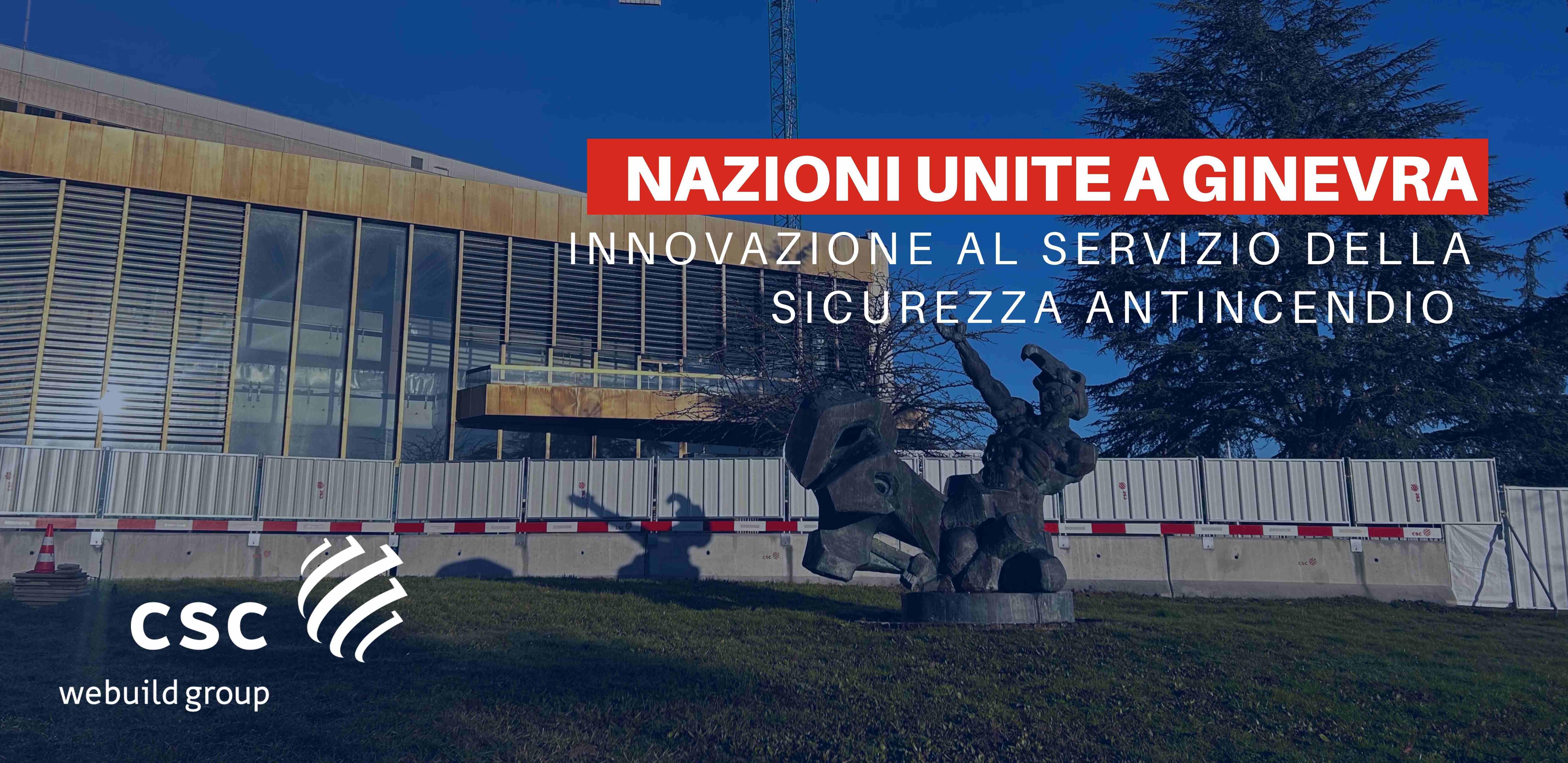
A risk-based approach applied to the refurbishment of a historic building in Geneva
On a major refurbishment project involving a historic and institutionally significant building, fire risk goes far beyond conventional construction hazards. When a building is partially decommissioned, its original safety systems are no longer fully operational, while new ignition sources, combustible materials, and sensitive areas may be present at the same time.
This creates a highly unstable environment in which the building itself becomes part of the risk scenario.
The approach was developed by CSC Costruzioni (Webuild Group), as part of the renovation of a historic building in Geneva, involving large-scale refurbishment works, phased demolition activities, and continuous coactivity between active construction zones and sensitive areas.
In such conditions, the challenge is not only to prevent fire events, but to manage a risk that continuously evolves depending on construction phases, working hours, and partial occupancy.
A risk that must be measured, not assumed
The methodology is based on a simple but structured principle: quantifying risk through the combination of likelihood and impact. Each zone of the site is assessed across both dimensions, each scored from one to four, resulting in a total risk index ranging from one to sixteen.
This approach turns what is often treated as a qualitative judgement into an operational decision-making tool. High-risk areas become immediately visible, as do periods of reduced exposure, particularly when activities are temporarily stopped.
The objective is not to eliminate risk entirely, but to continuously redistribute it by moving critical situations away from the most vulnerable areas.
A layered protection strategy
The operational response is structured into several levels, each adapted to the level of exposure.
The first level consists of fundamental organisational measures. These include strict hot-work permit systems, trained personnel, fire extinguishing equipment positioned close to work areas, control of temporary electrical installations, and continuously maintained evacuation routes. Although simple and low-cost, these measures form the backbone of the entire system.
When risk increases, a second level reinforces detection capabilities. This includes regular thermographic inspections, smoke detection systems adapted to construction constraints, and linear heat detection systems designed to follow the evolution of works across changing areas.
Finally, the most sensitive zones are subject to a third level of protection combining continuous thermal monitoring, reinforced fire-watch rounds, and constant anomaly detection. On this project, this level was reserved for the most sensitive parts of the building, including historic rooms and areas with high heritage value.
Detecting before fire develops
Two technologies played a key role in this approach:
- The first is distributed fiber-optic linear heat detection. Also widely used in tunnels, this technology transforms a cable into a continuous sensor capable of detecting temperature variations over long distances and precisely locating hot spots, even in dusty and constantly changing construction environments.
- The second is radiometric thermal imaging. Each pixel corresponds to a real temperature measurement, enabling the identification of overheating components long before smoke or flames appear. On site, dozens of cameras were deployed to provide continuous coverage of both interior and exterior sensitive zones, connected to a centralized alarm system.
Radiometric thermal frames — each pixel is a measured temperature, so overheating shows up long before there is visible smoke.
A model transferable to other complex environments
Although developed by CSC Costruzioni, part of the Webuild Group, for a historic building refurbishment in Geneva, this approach is applicable to a wide range of contexts, including tunnel works, industrial shutdowns, and phased occupancy refurbishments.
Across all these cases, the principles remain the same: continuously assess risk, adapt protection levels to site reality, and combine organizational measures, technology, and human intervention in an evolving framework.
Conclusion
Fire safety on live construction sites can no longer be treated as a static system. It has become a dynamic mechanism for risk interpretation and resource allocation.
Beyond tools and technologies, the central challenge remains consistent: continuously identify the most exposed areas and adapt the response accordingly.
An approach in which safety does not only protect the site but also contributes to managing its complexity.